Search

Tuesday, April 22, 2008

Simhachalam

The hill temple of Simhachalam can be seen as one approaches Vishakapatnam from Vizianagaram by train. Simhachalam - the hill of the lion is located at a distance of 18 km from Vishakapatnam. The hill temple is accessed via a motorable road, up the hill. This temple combines the Orissan and Chalukyan features of temple construction, and it attracts scores of pilgrims from both Andhra Pradesh and Orissa.

The presiding deity here is Varaha Lakshminarasimha, combining the iconographic features of Varaha and Narasimha. The image resembles a Shivalingam covered with sandal paste. It is only once a year, during the Chandana Visarjana that the sandal paste is removed, and the image is seen by pilgrims.

Legend has it that the Ugra form of Narasimha as he killed the demon Hiranyakashipu was so fierce that the image is kept covered by sandal paste throughout the year.

Temple History: Kulottunga Chola I of Tamilnadu, made endowments to this temple, as evidenced from inscriptions dating back to the year 1087. The Vengi Chalukyas of Andhra Pradesh renovated the original shrine in the 11th century. Much of the structure as it stands to day is the result of renovation by Narasimha I, of the Eastern Ganga dynasty, in the second quarter of the 13th century CE. Krishna Deva Raya, the Vijayanagar monarch visited this temple in the year 1516, as seen from inscriptions here. There are as many as 525 inscriptions in this temple.

Noteworthy features of the temple: This temple boasts of a beautiful stone chariot drawn by horses. The Kalyana Mandapa within the temple has 16 pillars with bas reliefs depicting the incarnations of Vishnu. Narasimha, the man lion incarnation of Vishnu is seen in several depictions throughout the temple.

The artwork here has elements of similarity with that of Konark. Elephants, flowers and plants are portrayed in plenty. The outer walls of the sanctum depict images of a royal personality (said to be King Narasimha) in various postures.

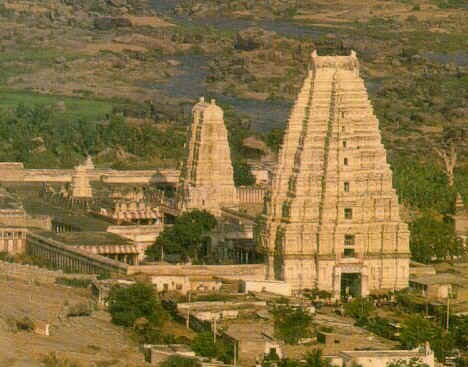
Virupaksha Temple at Hampi

Hampi, now in ruins is the site of the ancient city of Vijayanagar, capital of the Vijayanagar empire (founded under the spiritual guidance of Vidyaranya of Sringeri in early 14th century CE)) which brought about a renaissance of indigenous art and culture, as it defended the region against the plundering armies from elsewhere.

Much of Vijayanagar is now in ruins, as when the rulers were defeated at the hands of the invaders at the battle of Talikota in the 16th century, most of the marvelous structures and edifices were systematically destroyed.

Virupakasha Temple at Hampi

The Virupaksha or the Pampapathi temple is the main center of pilgrimage at Hampi. It is fully intact, and it incorporates some earlier structures. This temple has three towers, the eastern tower rises to a height of 160 feet and is nine tiered. It dates back to the first half of the fifteenth century and was renovated in the sixteenth century by Krishnadevaraya.

This tower has been built such that an inverted shadow of this huge tower falls on the western wall of the temple through a small hole behind the sanctum. The northern gopuram has five storeys, and the inner eastern gopuram is endowed with three storeys.

The presiding deity here is Virupaksheshwara or Pampapathi. His consort Pampa, is believed to be the daughter of Bhrama. There is an ornate shrine to Bhuvaneswari. There is a shrine to Vidyaranya, the spiritual founder of Vijayanagar in this temple. The inner prakaram consists of shrines and pillars dating back to the 12th century.

Krishnadevaraya also built a mandapam in front of the sanctum, and embellished it with Vijayanagar style bas reliefs and murals. Several of Shiva's manifestations, and the ten incarnations of Vishnu are portrayed here, as is the classic scene from Mahabharata depicting Arjuna's shooting the fish device in order to secure Draupadi's hand in marriage. There is also a mural depicting Vidyaranya the spiritual founder of Vijayanagar in procession.

In the vicinity of the Virupaksha temple are several dilapidated mandapams. In front of the temple was once an ancient shopping center lined with mandapams, the ruins of which stand today.

Festivals: The chariot festival in the month of February is the chief annual festival celebrated here. The divine marriage between Virupaksheshwara and Pampa is celebrated in the month of December.


The Temples of Karnataka

Karnataka has innumerable sites in the Temple Map of India, with its some of its still surviving monuments going back to the 7th century AD. The Badami Chalukyas were the builders of rock cut caves and ancient temple complexes.At Pattadakal, there are Temples in the Dravidian style along with Temples in styles that were later adopted in Eastern and Central India. The sculptural quality in these temples is outstanding. The subordinate rulers of the Chalukyas were the Gangas and the Kadambas.The colossal monolithic statue of Gomateswara was built by the Gangas in the 10th century AD. The Badami Chalukyas were succeeded by the Rashtrakutas and the Kalyani Chalukyas.In Southern Karnataka, the Hoysalas reigned supreme. The Hoysalas were great builders and they built great temples at Halebidu, Belur and Somanathapura. The Hoysalas built temples on raised complex star shaped platforms. This star shaped plan is carried all the way from the platform to the shikhara. Horizontal bands of sculptural motifs and monolithic pillars adorn these temples. There is a profusion of sculptural work in the Hoysala style of temple building.

Next, the Vijayanagar Empire marks the period of great Temple building activity in Karnataka and these temples are characterized by the building of pillared mandapas and lofty entrance towers. The Vijayanagar Empire was destroyed by the Deccan Sultanates in the 16th century and the ruins can be seen at Hampi. The Mysore Maharajas (Wodeyars) who ruled from around 1400 AD through the British period, with the brief lapse during Tipu Sultans rule, have also made contributions to temples in this State. The temples of the coastal region are markedly different in architectural styles and they resemble the Keralite temples to a larger extent.

Balakrishna Temple at Udupi near Mangalore(Karnataka)
Deities: Krishna

This is one of the holiest pilgrimage sites in Karnataka and is associated with Madhwacharya the religious leader and the pioneer of the Dvaita philosophy. This is a small temple and the beautiful image of Krishna is viewed through a grating called the Navagraha window. Also in Udupi are the Chandramowliswara and Ananteshwara Temples.

Access and Accomodation: Mangalore

Gavi Gangadhareshwara Temple at Bangalore(Karnataka)
Deities:
Gangadareshwara(Shiva)

This cave temple dedicated to Shiva in Bangalore is a well visited one. The temple yard here contains several monolithic sculptures.On Makara Shankaranti each year, the suns' rays pass through the horns of the Nandi and illuminates the deity.

Access and Accomodation: Bangalore

Hoysaleswara Temple at Halebidu near Hassan(Karnataka)
Deities:
Hoysaleswara (Shiva)

Halebidu was the original capital of the Hoysala kingdom. The Hoysaleswara temple dedicated to Shiva was built in the 12th century. This can be described as the most beautiful of the Hoysala Temples. Thousands and thousands of figures adorn the walls.This temple is indeed a masterpiece in design and it attracts visitors from around the world. The Kedareswara temple in Halebidu now in a dilapidated state is a masterpiece of creation. Three ornate Jain Temples also adorn Halebidu.

Access and Accomodation: Hassan

Kesava Temple at Somnathapura near Mysore(Karnataka)
Deities:
Kesava (Vishnu)

This temple dating back to the 13th century is a masterpeice of Hoysala genius. It is a grand structure of great beauty, perfect symmetry and contains a wealth of sculpture. It attracts visitors from around the world.

Access and Accomodation: Mysore

Mahadeva Temple at Itgi near Raichur(Karnataka)
Deities: Mahadeva (Shiva)

This temple dedicated to Shiva is considered to be one of the best Chalukyan Temples. It is splendidly decorated. The richly carved pillars, beautiful inner hall, and the shikhara are its highlights.

Access and Accomodation: Raichur

Markandeshwara Temple at Kallur near Raichur(Karnataka)
Deities:
Markandeshwara (Shiva)

Krishnadevaraya of the Vijayanagar Empire is said to have worshipped at the six temples in this town with his family. The Markandeshwara is the oldest with beautifully carved, polished pillars.

Access and Accomodation: Raichur

Nandi Temples at Nandi Hills near Bangalore(Karnataka)
Deities:
Bhoganandiswara, Yoganandiswara (Shiva)

The Bhoganandiswara temple at the foothills of Nandi Hills goes back to the period of the Banas, Cholas, Hoysalas and the Vijayanagar Kings.. Bhoganandiswara, Umamaheswara and Arunachaleswara are enshrined here. The kalyanamandapa is of great beauty here.The Yoganandiswara temple atop the hill goes back to the Chola period. It received extensive patronage from the Vijayanagar Kings. The pillars and metalwork deserve special mention.

Access and Accomodation: Bangalore

Navalinga Temples at Kuknur near Hospet(Karnataka)
Deities: Shiva

This temple enshrines nine lingams in nine temples, with elegantly carved pillars and it dates back to the Rashtrakuta times. Kuknur is located near Yelbarga in Raichur District.

Access and Accomodation: Hospet

Omkareshwara Temple at Madikeri(Karnataka)
Deities: Omkareshwara (Shiva)

This temple deidcated to Shiva was built in the 19th century in a mix of Gothic and Islamic styles. It is built around a central pool. Mercara is situated in the beautiful Kodagu district in the Western Ghats.

Access and Accomodation: Madikeri

Vidyashankara Temple at Sringeri near Mangalore(Karnataka)
Deities:
Vidyashankara

This temple combines the Hoysala and Dravida features. Twelve pillars in this temple mark the 12 zodiac signs, and the sun's rays fall on each of them in the order of the solar months.
This temple dates back to the 14th century to the founding days of the Vijayanagar Kingdom. Sringeri is a grand seat of the Sankaracharya order established by the religious leader Adi Sankara.

Access and Accomodation: Mangalore

Vithala Temple at Hampi near Hospet(Karnataka)
Deities:
Vithala

This is one of the most ornate Vijayanagar Temples and was built over a period of time. This temple is known for extensive sculptural work. The ornate pillars deserve mention.

Panchavarneswarar Temple

Location of the templeTiruMookkicharam (woraiyur, Trichy)
Lord Shiva known asPanchavarneswarar, Thanthondreeswarar
Female deity known asKanthimathi Ammai
PathigamSambandar - 1
How to reach This temple is located in Tiruchirapalli city at Uraiyur.

Temple: Uraiyur, the heart of Tiruchi Town hardly 1 Km from the Cauvery, sports one of the oldest and greatest Shiva Temples in Chola Naadu. This temple tucked away behind tall business complexes on Salai road was built in the 8th century by the great Pandiya King Varaguna Maharaja II. The inscription dated 885 AD has referred to the donation of gold coins to the village sabha for performing poojas to the temple. Inscription in the Rcokfort Thaymanavar temple at Tiruchirapalli also speak of the donations by the great padiya king Varagunaa Maharaja II.

At the entrance, a beautiful and richly decorated Nandi greets the visitor. The temple has a maha Mandapam, ardha mandapam and a sanctum sanctorum. The lingam in the sanctum is small in size. Lord Shiva is known as Panchavarneswarar as he is said to have manifested Himself in 5 different colours to Utanga Munivar. The shrine for Utanga Munivar is situated directly across the main sanctum. Inside the sanctum sanctorum is the magnificent, tall lingam of Thanthondreeswarar, with a huge impressive base. Goddess Kanthimathi Ammai, the consort of Panchavarneswarar adorns Ankusam and Lotus in her two hands and faces north. Close to the shrine, one can see the images of Mahavishnu, the sun god, Lord Saneeswara and Kala Bhairavamurthy.

In the arthamanadapam, at the entrance to the sanctum sanctorum, there are two brilliant six feet tall Dwarapalakas with typical 8th century features. Both the images are brilliantly docorated. The southern wall of sanctum sanctorum is adorned with the image of Dakshinamoorthy and the northern wall with that of Lord Brahma. The 4 feet tall granite idol of Chandikeswara inside the shrine on the northern side is one of the tallest granite idols.This temple was renovated in the year 2002.

Garuda, Kasyapa Muni and Karkotakan are said to have worshipped here. Pugazh Chola Nayanar and Ko Chenkat Cholan, who built 78 Maadakkovils for Lord Shiva, were born here.

Legend: There are many references to the early chola capital Uraiyur. Uraiyur is referred as Tirumookicharam in Tevaram hymns (Pathigams). It is said that the great chola king Karikalan was once crossing this sivasthalam with his army. The legend holds that a fowl engaged in a battle with an elephant of the king's army and defeated it. King Karikalan realised that when a fowl of this place can defeat an elephant, the place should have been blessed with divine powers. The king constructed a city at this place and named it as Uraiyur

Mahalingeswarar Temple, Tiruvidaimarudur


Location of the templeTiruvidaimarudur
Lord Shiva known asMahalingeswarar, Marudhappar
Female deity known asBruhath Sundarakusaambaal, Nanmulainayagi, Perunalamulainayagi
PathigamThirunavukarasar, Sundarar
How to reach This famous sivasthalam is located 9 Kms from Kumbakonam. Town bus facilities are available from Kumbakonam. There is also a railway station at Tiruvidaimarudur on the Kumbakonam - Mayiladuturai section of the Southern Railway.

Temple: The Shivasthalam at Tiruvidaimarudur on the banks of river Cauvery is one of the 6 most sacred places on par with Varanasi (Benares).

This Shiva temple at Tiruvidaimarudur is about 1200 years old and is a big temple with lofty gopurams and lengthy corridors. This sivasthalam is popularly known as Madhyaarjunam. The term Madhyaarjunam tranlates into "Idaimarudhu" in Tamil language. Arjunam refers to Marudhamaram, the sthalavriksham of this temple. The temple has 3 prakarams ( corridors) and according to many legends associated with the temple, it is considered highly auspicious to do a pradakshinam (a circumambulatory walk through the corridors) on these 3 corridors.

  • Aswamedha praharam: This prakaram or corridor is the outermost prakaram and doing pradhakshinam in this praharam will give the effect of doing Ashwamedha yagam.
  • Kodumudi praharam: This is the middle corridor and doing pradakshinam in this prakaram will give the effect of visiting Mount Kailash - the Abode of Lord Shiva.
  • Pranava praharam: This the innermost corridor and doing pradakshinam in this prakaram will give mokshaa (salavation).

This temple is also known as Panchalinga Sthalam as the main deity is surrounded on four corners by temples dedicated to Vishwanathar, Aatmanathar, Rishipureeshwarar and Chokkanathar.

Because of the glory and importance of the temple at Tiruvidaimarudur, some nearby temples in the vicinity of Tiruvadiamarudur are referred as Parivara Devatha shrines. They are


  • Tiruvalanchuzi - Vinayakar
  • Swamimalai - Murugar (one of the 6 Abodes of Lord Muruguar)
  • Tiruvarur - Somaskandar
  • Chidambaram - Natarajar
  • Alangudi - Dhakshinamoorthy
  • Tiruvavaduthurai - Nandhikeshwarar
  • Tiruchaignallur - Chandikeshwarar
  • Srikazhi - Bhairavar
  • Sooriyanar Koil - Navagrahams

Significance: This temple is associated with the life of King Varaguna Pandian of Pandiya Naadu. The king was once returning to his capital after a hunting trip to nearyby forests. It was after sunset and the king was riding on a horse. He unwittingly killed a brahmin riding over him. Thus he was afflicted with Brahmahathi dosham (the sin of killing a brahmin) and further was possessed by the spirit of the dead brahmin. The king was an ardent devotee of Lord Shiva and offered prayers to the God to free him from the Brahmahathi Dosham. One day Lord Somasundarar of Madurai appeared in his dreams and advised him to visit Tiruvidaimarudur. Accordingly the king Varaguna Pandian visited Tiruvidaimarudur and when he entered the temple, the spirit of the dead brahmin did not have the courage to enter the sanctum of Lord Shiva and stayed behind hoping to catch the king once again when he came out of the temple. But the king was directed by Lord Shiva to exit through the west gate of the temple and was thus relieved from the Brahmahathi dosham. Even today the practice of entering the temple through the main entrance and exiting through the west gate is followed by all the visitors and devotees to the temple.

Lord Shiva gave darshan and appeared in the form of Arthanareeswarar to sage Markandeyar as desired by the sage at this sivasthalam. A separate shrine for Mookambikai, situated to the south of the shrine for presiding female deity, is of special importance at this temple. It is to be noted that shrines for Goddess Mookambikai are only at two places in India, one at Tiruvidaimarudur and the other one second at Kollur in Karnakata state.

Great Saints like Agasthyar, Adi Shankaracharya, Pattinathar, Sridhara Venkatesa Ayyaval, Bodhendra Saraswathi (59th Peedathipathi of Kanchi Kamakoti Peetam), Badragiriar, Arunagirirnathar had visited this shrine and worshipped the lord. It is believed that when Adi Shakara worshipped, the Lord Mahalingeshwarar uttered "Sathyam Advaitham" three times. It is also believed that Sridhara Ayyaval a great Shiva bhatka has merged with the Lord as a joyti (light). Sri Bodhendra Saraswathi's jeeva samadhi is also situated in Govindapuram near Tiruvidaimaruthur.

Temples in Tamilnadu - An introduction!

Eventhough there are many Shiva Temples in India and also in some other parts of the world, Temples in Tamilnadu have special significance. These Shiva Temples, glorified in Tamil Tevaram hymns, are referred as Paadal Petra Shiva Sthalangal. These Shiva Temples have been in existence for more than 1000 years because reference to these temples are found in Tevaram Hymns which were composed and authored by the 3 Nayanamar viz., Thirunavukarasar, Sambandar and Sundarar who lived between 7th and 9th century A.D. These hymns throw more light on Tamilnadu Temples, its art treasures, culture, civilization etc.

Some of these Shiva Temples, glorified and referred as Paadal Petra Shiva Sthalams, are among the greatest in the world and include temples carved in solid rock, huge temples with elaborately sculptured towers, all ornamented with delicate decorative work. Most of these temples are of stone, though a few are of brick. Artists carved the exterior and sometimes the interior with hundreds of figures of Gods, people, animals and plants. Most temples have one or several pillared halls called mandapam. Worshippers pass through the halls to a garbhagraha (sanctum sanctorum) where the idol of the temple's main deity (God or Goddess) is housed.

These temples are the torchbearers of the glorious heritage of Tamilnadu and stand out as architectural marvels. The majestic, ornate and soaring towers (known as Gopuram) are typical of Tamilnadu Temple architecture.

Temples have always been a central aspect of the social and culturual life of the people of Tamilnadu. Temples were not only places of worship, they were also places where people came together to meet, to exchange ideas and socialise. They were the centre of cultural activities of the village or area surrounding them. Apart from that, these Shiva Temples came to be associated with legends and beliefs that have over the years became a part of its historical make-up.

List of Shiva Temples (275)


1. Aakkoor 139. Tirukkollikkadu
2. Aalavaai (Madurai) 140. Tirukkonamalai
3. Aappudaiyaar Kovil 141. Tirukkondeeswaram
4. Aavoor Pasupateeswaram 142. Tirukkottaru
5. Achaleswaram 143. Tirukkovalur Veerattam
6. Ambar 144. Tirukkozhambam
7. Ambar Maakaalam 145. Tirukkudamuzhukku
8.Anbilalanturai 146. Tirukkudandai Keezhkottam
9. Anekatangavadam (Gowrikund) 147. Tirukkudavaayil
10. Anniyur 148. Tirukkurukaavur
11. Aradaipperumpazhi 149. Tirukkurukkai
12. Arankandanallur 150. Tirumaagaral
13. Arasili 151. Tirumaanikkuzhi
14. Arisirkaraiputtur 152. Tirumaanturai
15. Arurparavaiumandali 153. Tirumalper
16. Avalivanallur 154. Tirumanancheri
17. Avinaasi 155. Tirumangalakkudi
18. Dharumapuram 156. Tirumannippadikkarai
19. Edirkolpaadi 157. Tirumaraikkadu
20. Erukkattampuliyur 158. Tirumarugal
21. Gokarnam 159. Tirumayilai (Mylapore)
22. Goodalaiyatrur 160. Tirumazhapadi
23. Ilambayankottur 161. Tirumeeyachur
24. Indraneelaparvatam(Nepal) 162. Tirumeeyachur Ilamkovil
25. Innambar 163. Tirumudukunram
26. Irumbai Maakalam 164. Tirumullaivayil
27. Kachi Anekatangapadam 165. Tirumundeeswaram
28. Kachi Ekambam 166. Tirumuruganpoondi
29. Kachi Metrali 167. Tirunaarayur
30. Kachi Nerikkaaraikkadu 168. Tirunaavalur
31. Kadambar Kovil 169. Tirunageswaram
32. Kadambur 170. Tirunallam
33. Kadikkulam 171. Tirunallar
34. Kaduvaaikaaraiputhur 172. Tirunallur
35. Kaichinam 173. Tirunallurpperumanam
36. Kalayanallur 174. Tirunalurmayaanam
37. Kalikkaamoor 175. Tirunanipalli
38. Kanjanoor 176. Tirunatyattankudi
39. Kannaar Kovil 177. Tirundudevankudi
40. Kanraappur 178. Tiruneedur
41. Karaveeram 179. Tiruneelakkudi
42. Karuppariyalur 180. Tiruneittanam
43. Karuvili Kottittai 181. Tirunellikka
44. Karuvoor Aanilai 182. Tirunelvayil
45. Keevalur 183. Tirunelvayil Aratturai
46. Kodikkarai 184. Tirunelveli
47. Kodimadachenkunroor (Tiruchengode) 185. Tirunelvennei
48. Kottaiyur 186. Tiruninriyur
49. Kottur 187. Tiruppaachilasramam
50. Koyil (Chidambaram) 188. Tiruppaalaitturai
51. Kudandaikkaaronam 189. Tiruppaampuram
52. Kurakkukka 190. Tiruppaasur
53. Kurangaaduturai 191. Tiruppaatirippuliyur
54. Kuranganilmuttam 192. Tiruppaatrurai
55. Kutralam 193. Tiruppainneeli
56. Mahendrapalli 194. Tiruppanaiyur
57. Mayiladuturai 195. Tiruppanantaal
58. Melaittirukkattuppalli 196. Tirupparaaitturai
59. Nagaikkaronam 197. Tirupparankunram
60. Nannilam 198. Tiruppariyalur
61. Naraiyur 199. Tirupparuppatham(Sree Sailam - Andhra Pradesh)
62. Nedunkalam 200. Tiruppayatrankudi
63. Omampuliyur 201. Tiruppazhanam
64. Onakanthan Tali 202. Tiruppazhuvur(Aalanturai)
65. Paadaaleeswaram 203. Tirupperumpuliyur
66. Paandikkodumudi 204. Tiruppoonturutti
67. Pallavaneeswaram 205. Tiruppoovanam
68. Palliyin Mukkoodal 206. Tiruppoovanur
69. Panankattur 207. Tiruppugalur
70. Pandanainallur 208. Tiruppugalur Vardhamaneswaram
71. Paridiniyamam 209. Tiruppullamangai
72. Patteeswaram 210. Tiruppunavayil
73. Pazhaiyarai Vadatali 211. Tiruppunkur
74. Pennaagadam 212. Tiruppurampayam
75. Penu Perunturai 213. Tirupputhur
76. Pereyil 214. Tiruttalaichankadu
77. Peruvelur 215. Tiruttelicheri
78. Pullirukkuvelur(Vaideeswaran Koyil) 216. Tiruttevur
79. Puravaar Panankattur 217. Tiruttinai Nagar
80. Ramanadeeswaram 218. Tirutturaiyur
81. Rameswaram 219. Tirutturutti
82. Satthi Mutram 220. Tiruvaadaanai
83.Sikkal 221. Tiruvaalkoliputrur
84. Sirkali 222. Tiruvaappaadi
85. Sirukudi 223. Tiruvaikavur
86. Sivapuram 224. Tiruvaimur
87. Sree Kaalahasti 225. Tiruvaiyaru
88. Talaiyalankadu 226. Tiruvakkarai
89. Tandalaineeneri 227. Tiruvalampozhil
90. Ten Kurangaaduturai 228. Tiruvalampuram
91. Ten Tirumullaivayil 229. Tiruvalanchuzhi
92. Tenkoor 230. Tiruvalankadu
93. Tenkudittittai 231. Tiruvalithaayam
94. Thilataipati 232. Tiruvallam
95. Tiru Aamaathur 233. Tiruvanchiyam
96. Tiru Aanaikkaa 234. Tiruvanjaikkalam
97. Tiru Acharapakkam 235. Tiruvanmyur
98. Tiru Agathiyan Palli 236. Tiruvannamalai
99. Tiru Nana 237. Tiruvanniyur
100. Tiru Usaattaanam 238. Tiruvarur
101. Tiruchaaikaadu 239. Tiruvatikai
102. Tiruchaattamangai 240.Tiruvavaduturai
103. Tiruchakrapalli 241. Tiruvazhundur
104. Tirucheignalur 242. Tiruvedakam
105. Tiruchemponpalli 243. Tiruvedikkudi
106. Tiruchenkattankudi 244. Tiruveengoimalai
107. Tirucherai 245. Tiruveezhimizhalai
108. Tiruchirappalli 246. Tiruvelvikudi
109. Tiruchitremam 247. Tiruvenkadu
110. Tiruchopuram 248. Tiruvennainallur
111. Tiruchotrutturai 249. Tiruvenniyur (Koyil venni)
112. Tiruchuzhial 250. Tiruvenpakkam
113. Tiruidumbavanam 251. Tiruverkadu
114. Tirukkaanaattumulloor 252. Tiruverumbur
115. Tirukkaanapper 253. Tiruvetkalam
116. Tirukkaanoor 254. Tiruvettakkudi
117. Tirukkachoor 255. Tiruvidaichuram
118. Tirukkadaimudi 256. Tiruvidaimarudur
119. Tirukkadavur 257. Tiruvidaivai
120. Tirukkadavur Mayaanam 258. Tiruvidaiyaru
121. Tirukkalar 259. Tiruvirkolam
122. Tirukkallil 260. Tiruvirumpoolai
123. Tirukkalunkunram 261. Tiruviyalur
124. Tirukkandiyur 262. Tiruvooral
125. Tirukkarayil 2 63. Tiruvothur
126. Tirukkarkudi(Uyyakkondan Malai) 264. Tiruvotriyur
127. Tirukkarukaavoor 265. Uraiyur
128. Tirukkarukkudi 266. Vaatpokki
129. Tirukkattuppalli 267. Vaikanmaadakkovil
130. Tirukkayilaayam (Mount Kailash) 268. Valivalam
131. Tirukkazhippalai 269. Vanduturai
132. Tirukkedaram (Kedarnath) 270. Vatukur
133. Tirukketheeswaram 271. Venchamaakoodal
134. Tirukkodikka 272. Viilanagar
135. Tirukkodunkunram 273. Vijayamangai
136. Tirukkolakka 274. Vilamar
137. Tirukkolili 275. Virkudi
138. Tirukkollampudur