Search

Tuesday, April 22, 2008

Simhachalam

The hill temple of Simhachalam can be seen as one approaches Vishakapatnam from Vizianagaram by train. Simhachalam - the hill of the lion is located at a distance of 18 km from Vishakapatnam. The hill temple is accessed via a motorable road, up the hill. This temple combines the Orissan and Chalukyan features of temple construction, and it attracts scores of pilgrims from both Andhra Pradesh and Orissa.

The presiding deity here is Varaha Lakshminarasimha, combining the iconographic features of Varaha and Narasimha. The image resembles a Shivalingam covered with sandal paste. It is only once a year, during the Chandana Visarjana that the sandal paste is removed, and the image is seen by pilgrims.

Legend has it that the Ugra form of Narasimha as he killed the demon Hiranyakashipu was so fierce that the image is kept covered by sandal paste throughout the year.

Temple History: Kulottunga Chola I of Tamilnadu, made endowments to this temple, as evidenced from inscriptions dating back to the year 1087. The Vengi Chalukyas of Andhra Pradesh renovated the original shrine in the 11th century. Much of the structure as it stands to day is the result of renovation by Narasimha I, of the Eastern Ganga dynasty, in the second quarter of the 13th century CE. Krishna Deva Raya, the Vijayanagar monarch visited this temple in the year 1516, as seen from inscriptions here. There are as many as 525 inscriptions in this temple.

Noteworthy features of the temple: This temple boasts of a beautiful stone chariot drawn by horses. The Kalyana Mandapa within the temple has 16 pillars with bas reliefs depicting the incarnations of Vishnu. Narasimha, the man lion incarnation of Vishnu is seen in several depictions throughout the temple.

The artwork here has elements of similarity with that of Konark. Elephants, flowers and plants are portrayed in plenty. The outer walls of the sanctum depict images of a royal personality (said to be King Narasimha) in various postures.

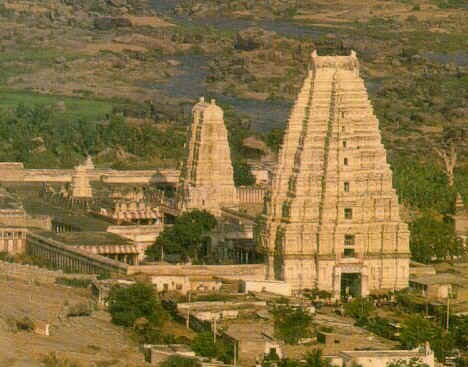
Virupaksha Temple at Hampi

Hampi, now in ruins is the site of the ancient city of Vijayanagar, capital of the Vijayanagar empire (founded under the spiritual guidance of Vidyaranya of Sringeri in early 14th century CE)) which brought about a renaissance of indigenous art and culture, as it defended the region against the plundering armies from elsewhere.

Much of Vijayanagar is now in ruins, as when the rulers were defeated at the hands of the invaders at the battle of Talikota in the 16th century, most of the marvelous structures and edifices were systematically destroyed.

Virupakasha Temple at Hampi

The Virupaksha or the Pampapathi temple is the main center of pilgrimage at Hampi. It is fully intact, and it incorporates some earlier structures. This temple has three towers, the eastern tower rises to a height of 160 feet and is nine tiered. It dates back to the first half of the fifteenth century and was renovated in the sixteenth century by Krishnadevaraya.

This tower has been built such that an inverted shadow of this huge tower falls on the western wall of the temple through a small hole behind the sanctum. The northern gopuram has five storeys, and the inner eastern gopuram is endowed with three storeys.

The presiding deity here is Virupaksheshwara or Pampapathi. His consort Pampa, is believed to be the daughter of Bhrama. There is an ornate shrine to Bhuvaneswari. There is a shrine to Vidyaranya, the spiritual founder of Vijayanagar in this temple. The inner prakaram consists of shrines and pillars dating back to the 12th century.

Krishnadevaraya also built a mandapam in front of the sanctum, and embellished it with Vijayanagar style bas reliefs and murals. Several of Shiva's manifestations, and the ten incarnations of Vishnu are portrayed here, as is the classic scene from Mahabharata depicting Arjuna's shooting the fish device in order to secure Draupadi's hand in marriage. There is also a mural depicting Vidyaranya the spiritual founder of Vijayanagar in procession.

In the vicinity of the Virupaksha temple are several dilapidated mandapams. In front of the temple was once an ancient shopping center lined with mandapams, the ruins of which stand today.

Festivals: The chariot festival in the month of February is the chief annual festival celebrated here. The divine marriage between Virupaksheshwara and Pampa is celebrated in the month of December.


The Temples of Karnataka

Karnataka has innumerable sites in the Temple Map of India, with its some of its still surviving monuments going back to the 7th century AD. The Badami Chalukyas were the builders of rock cut caves and ancient temple complexes.At Pattadakal, there are Temples in the Dravidian style along with Temples in styles that were later adopted in Eastern and Central India. The sculptural quality in these temples is outstanding. The subordinate rulers of the Chalukyas were the Gangas and the Kadambas.The colossal monolithic statue of Gomateswara was built by the Gangas in the 10th century AD. The Badami Chalukyas were succeeded by the Rashtrakutas and the Kalyani Chalukyas.In Southern Karnataka, the Hoysalas reigned supreme. The Hoysalas were great builders and they built great temples at Halebidu, Belur and Somanathapura. The Hoysalas built temples on raised complex star shaped platforms. This star shaped plan is carried all the way from the platform to the shikhara. Horizontal bands of sculptural motifs and monolithic pillars adorn these temples. There is a profusion of sculptural work in the Hoysala style of temple building.

Next, the Vijayanagar Empire marks the period of great Temple building activity in Karnataka and these temples are characterized by the building of pillared mandapas and lofty entrance towers. The Vijayanagar Empire was destroyed by the Deccan Sultanates in the 16th century and the ruins can be seen at Hampi. The Mysore Maharajas (Wodeyars) who ruled from around 1400 AD through the British period, with the brief lapse during Tipu Sultans rule, have also made contributions to temples in this State. The temples of the coastal region are markedly different in architectural styles and they resemble the Keralite temples to a larger extent.

Balakrishna Temple at Udupi near Mangalore(Karnataka)
Deities: Krishna

This is one of the holiest pilgrimage sites in Karnataka and is associated with Madhwacharya the religious leader and the pioneer of the Dvaita philosophy. This is a small temple and the beautiful image of Krishna is viewed through a grating called the Navagraha window. Also in Udupi are the Chandramowliswara and Ananteshwara Temples.

Access and Accomodation: Mangalore

Gavi Gangadhareshwara Temple at Bangalore(Karnataka)
Deities:
Gangadareshwara(Shiva)

This cave temple dedicated to Shiva in Bangalore is a well visited one. The temple yard here contains several monolithic sculptures.On Makara Shankaranti each year, the suns' rays pass through the horns of the Nandi and illuminates the deity.

Access and Accomodation: Bangalore

Hoysaleswara Temple at Halebidu near Hassan(Karnataka)
Deities:
Hoysaleswara (Shiva)

Halebidu was the original capital of the Hoysala kingdom. The Hoysaleswara temple dedicated to Shiva was built in the 12th century. This can be described as the most beautiful of the Hoysala Temples. Thousands and thousands of figures adorn the walls.This temple is indeed a masterpiece in design and it attracts visitors from around the world. The Kedareswara temple in Halebidu now in a dilapidated state is a masterpiece of creation. Three ornate Jain Temples also adorn Halebidu.

Access and Accomodation: Hassan

Kesava Temple at Somnathapura near Mysore(Karnataka)
Deities:
Kesava (Vishnu)

This temple dating back to the 13th century is a masterpeice of Hoysala genius. It is a grand structure of great beauty, perfect symmetry and contains a wealth of sculpture. It attracts visitors from around the world.

Access and Accomodation: Mysore

Mahadeva Temple at Itgi near Raichur(Karnataka)
Deities: Mahadeva (Shiva)

This temple dedicated to Shiva is considered to be one of the best Chalukyan Temples. It is splendidly decorated. The richly carved pillars, beautiful inner hall, and the shikhara are its highlights.

Access and Accomodation: Raichur

Markandeshwara Temple at Kallur near Raichur(Karnataka)
Deities:
Markandeshwara (Shiva)

Krishnadevaraya of the Vijayanagar Empire is said to have worshipped at the six temples in this town with his family. The Markandeshwara is the oldest with beautifully carved, polished pillars.

Access and Accomodation: Raichur

Nandi Temples at Nandi Hills near Bangalore(Karnataka)
Deities:
Bhoganandiswara, Yoganandiswara (Shiva)

The Bhoganandiswara temple at the foothills of Nandi Hills goes back to the period of the Banas, Cholas, Hoysalas and the Vijayanagar Kings.. Bhoganandiswara, Umamaheswara and Arunachaleswara are enshrined here. The kalyanamandapa is of great beauty here.The Yoganandiswara temple atop the hill goes back to the Chola period. It received extensive patronage from the Vijayanagar Kings. The pillars and metalwork deserve special mention.

Access and Accomodation: Bangalore

Navalinga Temples at Kuknur near Hospet(Karnataka)
Deities: Shiva

This temple enshrines nine lingams in nine temples, with elegantly carved pillars and it dates back to the Rashtrakuta times. Kuknur is located near Yelbarga in Raichur District.

Access and Accomodation: Hospet

Omkareshwara Temple at Madikeri(Karnataka)
Deities: Omkareshwara (Shiva)

This temple deidcated to Shiva was built in the 19th century in a mix of Gothic and Islamic styles. It is built around a central pool. Mercara is situated in the beautiful Kodagu district in the Western Ghats.

Access and Accomodation: Madikeri

Vidyashankara Temple at Sringeri near Mangalore(Karnataka)
Deities:
Vidyashankara

This temple combines the Hoysala and Dravida features. Twelve pillars in this temple mark the 12 zodiac signs, and the sun's rays fall on each of them in the order of the solar months.
This temple dates back to the 14th century to the founding days of the Vijayanagar Kingdom. Sringeri is a grand seat of the Sankaracharya order established by the religious leader Adi Sankara.

Access and Accomodation: Mangalore

Vithala Temple at Hampi near Hospet(Karnataka)
Deities:
Vithala

This is one of the most ornate Vijayanagar Temples and was built over a period of time. This temple is known for extensive sculptural work. The ornate pillars deserve mention.

Panchavarneswarar Temple

Location of the templeTiruMookkicharam (woraiyur, Trichy)
Lord Shiva known asPanchavarneswarar, Thanthondreeswarar
Female deity known asKanthimathi Ammai
PathigamSambandar - 1
How to reach This temple is located in Tiruchirapalli city at Uraiyur.

Temple: Uraiyur, the heart of Tiruchi Town hardly 1 Km from the Cauvery, sports one of the oldest and greatest Shiva Temples in Chola Naadu. This temple tucked away behind tall business complexes on Salai road was built in the 8th century by the great Pandiya King Varaguna Maharaja II. The inscription dated 885 AD has referred to the donation of gold coins to the village sabha for performing poojas to the temple. Inscription in the Rcokfort Thaymanavar temple at Tiruchirapalli also speak of the donations by the great padiya king Varagunaa Maharaja II.

At the entrance, a beautiful and richly decorated Nandi greets the visitor. The temple has a maha Mandapam, ardha mandapam and a sanctum sanctorum. The lingam in the sanctum is small in size. Lord Shiva is known as Panchavarneswarar as he is said to have manifested Himself in 5 different colours to Utanga Munivar. The shrine for Utanga Munivar is situated directly across the main sanctum. Inside the sanctum sanctorum is the magnificent, tall lingam of Thanthondreeswarar, with a huge impressive base. Goddess Kanthimathi Ammai, the consort of Panchavarneswarar adorns Ankusam and Lotus in her two hands and faces north. Close to the shrine, one can see the images of Mahavishnu, the sun god, Lord Saneeswara and Kala Bhairavamurthy.

In the arthamanadapam, at the entrance to the sanctum sanctorum, there are two brilliant six feet tall Dwarapalakas with typical 8th century features. Both the images are brilliantly docorated. The southern wall of sanctum sanctorum is adorned with the image of Dakshinamoorthy and the northern wall with that of Lord Brahma. The 4 feet tall granite idol of Chandikeswara inside the shrine on the northern side is one of the tallest granite idols.This temple was renovated in the year 2002.

Garuda, Kasyapa Muni and Karkotakan are said to have worshipped here. Pugazh Chola Nayanar and Ko Chenkat Cholan, who built 78 Maadakkovils for Lord Shiva, were born here.

Legend: There are many references to the early chola capital Uraiyur. Uraiyur is referred as Tirumookicharam in Tevaram hymns (Pathigams). It is said that the great chola king Karikalan was once crossing this sivasthalam with his army. The legend holds that a fowl engaged in a battle with an elephant of the king's army and defeated it. King Karikalan realised that when a fowl of this place can defeat an elephant, the place should have been blessed with divine powers. The king constructed a city at this place and named it as Uraiyur

Mahalingeswarar Temple, Tiruvidaimarudur


Location of the templeTiruvidaimarudur
Lord Shiva known asMahalingeswarar, Marudhappar
Female deity known asBruhath Sundarakusaambaal, Nanmulainayagi, Perunalamulainayagi
PathigamThirunavukarasar, Sundarar
How to reach This famous sivasthalam is located 9 Kms from Kumbakonam. Town bus facilities are available from Kumbakonam. There is also a railway station at Tiruvidaimarudur on the Kumbakonam - Mayiladuturai section of the Southern Railway.

Temple: The Shivasthalam at Tiruvidaimarudur on the banks of river Cauvery is one of the 6 most sacred places on par with Varanasi (Benares).

This Shiva temple at Tiruvidaimarudur is about 1200 years old and is a big temple with lofty gopurams and lengthy corridors. This sivasthalam is popularly known as Madhyaarjunam. The term Madhyaarjunam tranlates into "Idaimarudhu" in Tamil language. Arjunam refers to Marudhamaram, the sthalavriksham of this temple. The temple has 3 prakarams ( corridors) and according to many legends associated with the temple, it is considered highly auspicious to do a pradakshinam (a circumambulatory walk through the corridors) on these 3 corridors.

  • Aswamedha praharam: This prakaram or corridor is the outermost prakaram and doing pradhakshinam in this praharam will give the effect of doing Ashwamedha yagam.
  • Kodumudi praharam: This is the middle corridor and doing pradakshinam in this prakaram will give the effect of visiting Mount Kailash - the Abode of Lord Shiva.
  • Pranava praharam: This the innermost corridor and doing pradakshinam in this prakaram will give mokshaa (salavation).

This temple is also known as Panchalinga Sthalam as the main deity is surrounded on four corners by temples dedicated to Vishwanathar, Aatmanathar, Rishipureeshwarar and Chokkanathar.

Because of the glory and importance of the temple at Tiruvidaimarudur, some nearby temples in the vicinity of Tiruvadiamarudur are referred as Parivara Devatha shrines. They are


  • Tiruvalanchuzi - Vinayakar
  • Swamimalai - Murugar (one of the 6 Abodes of Lord Muruguar)
  • Tiruvarur - Somaskandar
  • Chidambaram - Natarajar
  • Alangudi - Dhakshinamoorthy
  • Tiruvavaduthurai - Nandhikeshwarar
  • Tiruchaignallur - Chandikeshwarar
  • Srikazhi - Bhairavar
  • Sooriyanar Koil - Navagrahams

Significance: This temple is associated with the life of King Varaguna Pandian of Pandiya Naadu. The king was once returning to his capital after a hunting trip to nearyby forests. It was after sunset and the king was riding on a horse. He unwittingly killed a brahmin riding over him. Thus he was afflicted with Brahmahathi dosham (the sin of killing a brahmin) and further was possessed by the spirit of the dead brahmin. The king was an ardent devotee of Lord Shiva and offered prayers to the God to free him from the Brahmahathi Dosham. One day Lord Somasundarar of Madurai appeared in his dreams and advised him to visit Tiruvidaimarudur. Accordingly the king Varaguna Pandian visited Tiruvidaimarudur and when he entered the temple, the spirit of the dead brahmin did not have the courage to enter the sanctum of Lord Shiva and stayed behind hoping to catch the king once again when he came out of the temple. But the king was directed by Lord Shiva to exit through the west gate of the temple and was thus relieved from the Brahmahathi dosham. Even today the practice of entering the temple through the main entrance and exiting through the west gate is followed by all the visitors and devotees to the temple.

Lord Shiva gave darshan and appeared in the form of Arthanareeswarar to sage Markandeyar as desired by the sage at this sivasthalam. A separate shrine for Mookambikai, situated to the south of the shrine for presiding female deity, is of special importance at this temple. It is to be noted that shrines for Goddess Mookambikai are only at two places in India, one at Tiruvidaimarudur and the other one second at Kollur in Karnakata state.

Great Saints like Agasthyar, Adi Shankaracharya, Pattinathar, Sridhara Venkatesa Ayyaval, Bodhendra Saraswathi (59th Peedathipathi of Kanchi Kamakoti Peetam), Badragiriar, Arunagirirnathar had visited this shrine and worshipped the lord. It is believed that when Adi Shakara worshipped, the Lord Mahalingeshwarar uttered "Sathyam Advaitham" three times. It is also believed that Sridhara Ayyaval a great Shiva bhatka has merged with the Lord as a joyti (light). Sri Bodhendra Saraswathi's jeeva samadhi is also situated in Govindapuram near Tiruvidaimaruthur.

Temples in Tamilnadu - An introduction!

Eventhough there are many Shiva Temples in India and also in some other parts of the world, Temples in Tamilnadu have special significance. These Shiva Temples, glorified in Tamil Tevaram hymns, are referred as Paadal Petra Shiva Sthalangal. These Shiva Temples have been in existence for more than 1000 years because reference to these temples are found in Tevaram Hymns which were composed and authored by the 3 Nayanamar viz., Thirunavukarasar, Sambandar and Sundarar who lived between 7th and 9th century A.D. These hymns throw more light on Tamilnadu Temples, its art treasures, culture, civilization etc.

Some of these Shiva Temples, glorified and referred as Paadal Petra Shiva Sthalams, are among the greatest in the world and include temples carved in solid rock, huge temples with elaborately sculptured towers, all ornamented with delicate decorative work. Most of these temples are of stone, though a few are of brick. Artists carved the exterior and sometimes the interior with hundreds of figures of Gods, people, animals and plants. Most temples have one or several pillared halls called mandapam. Worshippers pass through the halls to a garbhagraha (sanctum sanctorum) where the idol of the temple's main deity (God or Goddess) is housed.

These temples are the torchbearers of the glorious heritage of Tamilnadu and stand out as architectural marvels. The majestic, ornate and soaring towers (known as Gopuram) are typical of Tamilnadu Temple architecture.

Temples have always been a central aspect of the social and culturual life of the people of Tamilnadu. Temples were not only places of worship, they were also places where people came together to meet, to exchange ideas and socialise. They were the centre of cultural activities of the village or area surrounding them. Apart from that, these Shiva Temples came to be associated with legends and beliefs that have over the years became a part of its historical make-up.

List of Shiva Temples (275)


1. Aakkoor 139. Tirukkollikkadu
2. Aalavaai (Madurai) 140. Tirukkonamalai
3. Aappudaiyaar Kovil 141. Tirukkondeeswaram
4. Aavoor Pasupateeswaram 142. Tirukkottaru
5. Achaleswaram 143. Tirukkovalur Veerattam
6. Ambar 144. Tirukkozhambam
7. Ambar Maakaalam 145. Tirukkudamuzhukku
8.Anbilalanturai 146. Tirukkudandai Keezhkottam
9. Anekatangavadam (Gowrikund) 147. Tirukkudavaayil
10. Anniyur 148. Tirukkurukaavur
11. Aradaipperumpazhi 149. Tirukkurukkai
12. Arankandanallur 150. Tirumaagaral
13. Arasili 151. Tirumaanikkuzhi
14. Arisirkaraiputtur 152. Tirumaanturai
15. Arurparavaiumandali 153. Tirumalper
16. Avalivanallur 154. Tirumanancheri
17. Avinaasi 155. Tirumangalakkudi
18. Dharumapuram 156. Tirumannippadikkarai
19. Edirkolpaadi 157. Tirumaraikkadu
20. Erukkattampuliyur 158. Tirumarugal
21. Gokarnam 159. Tirumayilai (Mylapore)
22. Goodalaiyatrur 160. Tirumazhapadi
23. Ilambayankottur 161. Tirumeeyachur
24. Indraneelaparvatam(Nepal) 162. Tirumeeyachur Ilamkovil
25. Innambar 163. Tirumudukunram
26. Irumbai Maakalam 164. Tirumullaivayil
27. Kachi Anekatangapadam 165. Tirumundeeswaram
28. Kachi Ekambam 166. Tirumuruganpoondi
29. Kachi Metrali 167. Tirunaarayur
30. Kachi Nerikkaaraikkadu 168. Tirunaavalur
31. Kadambar Kovil 169. Tirunageswaram
32. Kadambur 170. Tirunallam
33. Kadikkulam 171. Tirunallar
34. Kaduvaaikaaraiputhur 172. Tirunallur
35. Kaichinam 173. Tirunallurpperumanam
36. Kalayanallur 174. Tirunalurmayaanam
37. Kalikkaamoor 175. Tirunanipalli
38. Kanjanoor 176. Tirunatyattankudi
39. Kannaar Kovil 177. Tirundudevankudi
40. Kanraappur 178. Tiruneedur
41. Karaveeram 179. Tiruneelakkudi
42. Karuppariyalur 180. Tiruneittanam
43. Karuvili Kottittai 181. Tirunellikka
44. Karuvoor Aanilai 182. Tirunelvayil
45. Keevalur 183. Tirunelvayil Aratturai
46. Kodikkarai 184. Tirunelveli
47. Kodimadachenkunroor (Tiruchengode) 185. Tirunelvennei
48. Kottaiyur 186. Tiruninriyur
49. Kottur 187. Tiruppaachilasramam
50. Koyil (Chidambaram) 188. Tiruppaalaitturai
51. Kudandaikkaaronam 189. Tiruppaampuram
52. Kurakkukka 190. Tiruppaasur
53. Kurangaaduturai 191. Tiruppaatirippuliyur
54. Kuranganilmuttam 192. Tiruppaatrurai
55. Kutralam 193. Tiruppainneeli
56. Mahendrapalli 194. Tiruppanaiyur
57. Mayiladuturai 195. Tiruppanantaal
58. Melaittirukkattuppalli 196. Tirupparaaitturai
59. Nagaikkaronam 197. Tirupparankunram
60. Nannilam 198. Tiruppariyalur
61. Naraiyur 199. Tirupparuppatham(Sree Sailam - Andhra Pradesh)
62. Nedunkalam 200. Tiruppayatrankudi
63. Omampuliyur 201. Tiruppazhanam
64. Onakanthan Tali 202. Tiruppazhuvur(Aalanturai)
65. Paadaaleeswaram 203. Tirupperumpuliyur
66. Paandikkodumudi 204. Tiruppoonturutti
67. Pallavaneeswaram 205. Tiruppoovanam
68. Palliyin Mukkoodal 206. Tiruppoovanur
69. Panankattur 207. Tiruppugalur
70. Pandanainallur 208. Tiruppugalur Vardhamaneswaram
71. Paridiniyamam 209. Tiruppullamangai
72. Patteeswaram 210. Tiruppunavayil
73. Pazhaiyarai Vadatali 211. Tiruppunkur
74. Pennaagadam 212. Tiruppurampayam
75. Penu Perunturai 213. Tirupputhur
76. Pereyil 214. Tiruttalaichankadu
77. Peruvelur 215. Tiruttelicheri
78. Pullirukkuvelur(Vaideeswaran Koyil) 216. Tiruttevur
79. Puravaar Panankattur 217. Tiruttinai Nagar
80. Ramanadeeswaram 218. Tirutturaiyur
81. Rameswaram 219. Tirutturutti
82. Satthi Mutram 220. Tiruvaadaanai
83.Sikkal 221. Tiruvaalkoliputrur
84. Sirkali 222. Tiruvaappaadi
85. Sirukudi 223. Tiruvaikavur
86. Sivapuram 224. Tiruvaimur
87. Sree Kaalahasti 225. Tiruvaiyaru
88. Talaiyalankadu 226. Tiruvakkarai
89. Tandalaineeneri 227. Tiruvalampozhil
90. Ten Kurangaaduturai 228. Tiruvalampuram
91. Ten Tirumullaivayil 229. Tiruvalanchuzhi
92. Tenkoor 230. Tiruvalankadu
93. Tenkudittittai 231. Tiruvalithaayam
94. Thilataipati 232. Tiruvallam
95. Tiru Aamaathur 233. Tiruvanchiyam
96. Tiru Aanaikkaa 234. Tiruvanjaikkalam
97. Tiru Acharapakkam 235. Tiruvanmyur
98. Tiru Agathiyan Palli 236. Tiruvannamalai
99. Tiru Nana 237. Tiruvanniyur
100. Tiru Usaattaanam 238. Tiruvarur
101. Tiruchaaikaadu 239. Tiruvatikai
102. Tiruchaattamangai 240.Tiruvavaduturai
103. Tiruchakrapalli 241. Tiruvazhundur
104. Tirucheignalur 242. Tiruvedakam
105. Tiruchemponpalli 243. Tiruvedikkudi
106. Tiruchenkattankudi 244. Tiruveengoimalai
107. Tirucherai 245. Tiruveezhimizhalai
108. Tiruchirappalli 246. Tiruvelvikudi
109. Tiruchitremam 247. Tiruvenkadu
110. Tiruchopuram 248. Tiruvennainallur
111. Tiruchotrutturai 249. Tiruvenniyur (Koyil venni)
112. Tiruchuzhial 250. Tiruvenpakkam
113. Tiruidumbavanam 251. Tiruverkadu
114. Tirukkaanaattumulloor 252. Tiruverumbur
115. Tirukkaanapper 253. Tiruvetkalam
116. Tirukkaanoor 254. Tiruvettakkudi
117. Tirukkachoor 255. Tiruvidaichuram
118. Tirukkadaimudi 256. Tiruvidaimarudur
119. Tirukkadavur 257. Tiruvidaivai
120. Tirukkadavur Mayaanam 258. Tiruvidaiyaru
121. Tirukkalar 259. Tiruvirkolam
122. Tirukkallil 260. Tiruvirumpoolai
123. Tirukkalunkunram 261. Tiruviyalur
124. Tirukkandiyur 262. Tiruvooral
125. Tirukkarayil 2 63. Tiruvothur
126. Tirukkarkudi(Uyyakkondan Malai) 264. Tiruvotriyur
127. Tirukkarukaavoor 265. Uraiyur
128. Tirukkarukkudi 266. Vaatpokki
129. Tirukkattuppalli 267. Vaikanmaadakkovil
130. Tirukkayilaayam (Mount Kailash) 268. Valivalam
131. Tirukkazhippalai 269. Vanduturai
132. Tirukkedaram (Kedarnath) 270. Vatukur
133. Tirukketheeswaram 271. Venchamaakoodal
134. Tirukkodikka 272. Viilanagar
135. Tirukkodunkunram 273. Vijayamangai
136. Tirukkolakka 274. Vilamar
137. Tirukkolili 275. Virkudi
138. Tirukkollampudur

Friday, April 18, 2008

LORD SUBRAMANIYA

ABOUT TEMPLE
The Sree Subramanya Swami Temple, Thazhakkara and the diety “Shadadhara Parathishta” of Lord Murugan has a historical presence of over 1000 years. Lord Murugan, assuming a human form representing a diety, holding a spig of paddy and Fire (Torch) showers blessings on his devotees. The Lord carrying spig of paddy is interpreted as the custodian of wealth.

The Lord is a great protector of his devotees and healer of physical and mental ailments. He protects each and every part of the body of his devotees and even the powerful Navagrahas would be passive because of his grace. He Himself is said to have told Naradan, "Those who have sought refuge in Me have no fear, they won't be left with any needs; those who are devoted to Me have no enemies, they have no diseases...".

Sree Subrahmanya Swami Temple
The temple stands as a symbol of cultural heritage, communal harmony and prosperity of the region. It is surrounded by rich greenery. Very recently, the temple has undergone several physical and spiritual renovations. It has attained the aura of a great temple. There is massive increase in number of pilgrims. The tide of devotees on shashti days is an evidence for this. Those who are visiting this website are requested to conduct a pilgrimage to the temple and experience the grace of Lord Subrahmanya Swamy.
The permanent assets of land, pond and 'sarpa kavu' of this temple is spread over an area of over 1.75 acres. The temple is under the administrative control of ‘Haindava Seva Samithi , a body registered under the 12th Travancore-Cochin Literary Science Charitable Act of 1955.


Brahmashree
Akkeeraman Kalidasan Battathiripadu The Shektra Tanthri is Brahmashree Kuzhikattillathu (Tiruvalla) Akkeeraman Kalidasan Battathiripadu, who gives all advice and guidance in maintaining the sanctity of temple and greatly devoted to Lord Subrahmanya. Melshanti is Brahmashree Jayakrishnan Namboothiri, Neduvelil Illom, Perunna who is responsible for the day-to-day pooja and rituals.

Upa Devadas

Though the main prathishta (idol) is Lord Subrahmanya [Murugan], there are also upa devatas: Lord Krishna, Shastha, Lord Shiva, Lord Ganesa, Devi, Yogeeswaran, Rakshas, Nagaraja, Nagayekshi, Mani nagas, Karinagas are the Upa devatas. Each of them has separate temple abodes and daily poojas.


Ayyappa Temple
Murali Krishna Temple
Bhuvaneswari Temple


Brahmarakshsu Temple
Ganapathy Temple
Shiva Temple

Yogeeshwara Temple

Sarpa Kavu (Serpent Grove)
Naga Devathas are residing in ‘Sarpa Kavu’ located in the north west side of the main temple. These groves are sacred and are abode to numerous divine serpants. The serpent deities are installed in 'Chitrakudas'. The ‘Sarpa Kavus’ are full of creepers and trees which are maintained and preserved for centuries as traditional water-harvesting system and it represent deep-rooted tradition of worshipping plants and animals. These sacred grooves are isolated fragments of dense forests with rich collection of flora and fauna. The ‘Kavus' are breeding grounds for land turtles, snakes, insects, bats, birds and other smaller animals.

Sarpa Kavu

Sarpa kavu

History
According to the Astrological Enquiry/search [Devaprasnam], this temple was built by a Yogeeswaran over thousand years ago. In the early rears, the temple was under Edapally Elangur Swarupam. Later the title of the temple was found handed over to the Waryath family. The temple had under its possession lots of moveable and immovable assets. Though the administration of the temple was under the Waryath family, major festivals were planned and managed by the Thazakkara No:71. N.S.S. Karayogam. In 1979, the temple was taken over by Sree Subrahmanya Haindava Seva Samithi.

Milestones
20-06-1979 Formation of Haindava Seva Samithi
23-06-1982 Ayyappa Temple
22-04-1999 Puna Prathishta & upa devadas
04-05-2001 Dhwaja Prathishta & Jeevatha
18-01-2003 Nalambalam
19-01-2003 Devi Temple
04-02-2004 Ganapathi Temple & Pradakshina track
During 2005-06 Total of 42 cents of land, adjacent to the temple, has been acquired in 4 phases
Feb 2006 Laying of granite slabs(Krishna shila) around Sreekovil


MAJOR FESTIVALS
Thypooyam
The main festivals of this temple are THYPOOYAM held during the Malayalam months of Makaram and in Medam. The morning ‘KAVADY PROCESSION’ from Kunnam Sreedharmmasasta temple and the evening. ‘BHASMAKAVADI’ from Puthiyakavu Devi Temple are also some of the auspicious functions of devotees.

Ten days festival
The festival starts with PARAYEDUPPU [receiving the offerings from the devotees at their doorstep] . With the hoisting of the temple flag on the day of Karthika, the festivities take off and will last for a period of 10 days with all the traditional rituals like "Utsavabali, Pallivetta and Aarattu". Seven days of Bhagavathaparayana (Saptahama) is also conducted during the ten days festival.

Other Important Days

Large number of devotees are observing “Shashti Vrutha” in every Malayalam month. The number is getting increased after each “shashti”. Besides the poojas conducted on Ayilyam day in the month of Thulam and CHIRAPPU in Vrischikam are also very important.

THE LEGEND

Subrahmanya is the second son of Lord Siva. His manifestation occurred when the Devas, the celestial people, were being oppressed by an Asura (demon) by the name of Taraka. He is the conjoint manifestation of Siva and Sakti.
When Siva was deeply absorbed in his spiritual exuberance, forgetting the world, he was disturbed by cupid (kamadevan). Sakti was also observing penance to get the grace of Siva. When Siva opened his eyes, he burnt cupid. At that time six flashes, like lightning emerged, five from the five senses and one from the mind of Siva. These became six babies and the cosmic mother Sakti rolled these into one baby (Lord Murugan) with six heads and twelve arms .
Because of this evolutionary process, Subrahmanya is also known as Shanmuka, six-faced one. The six heads represent six rays or attributes, viz., Wisdom, Dispassion, Strength, Fame, Wealth and Divine Power.
Another legend behind the Lord’s birth is as follows. In order to save the good [Devas] from wicked [Asuras], Lord Murugan was originated from the Holy Sparks of Lord Siva's third eye. The story goes that the sparks which flashed forth from the third eye of Siva rushed through space, which Vayu and Agni carried and dropped into the river Ganga. By the grace of the Lord, the sparks were carried by holy Ganga to Saravanappoikai. On arriving at the tank, the sparks assumed the form of six children of unparalleled beauty. Each baby was lying on a lotus and was being lulled to sleep by the Devis of the Karthikai (the 3rd constellation of the 27 Stars). To witness this Avatara of the Saviour, all the Devas hastened to the tank along with Lord Siva and Parvati. Parvati, out of the extreme fondness of a mother, took up the babes together and called them Skanda. Instead of them remaining as six separate individual babes, there arose the form of one Deity with six faces and twelve hands. Hence he was known as Lord Arumugaswamy or Shanmukha, the Lord with six faces. As he was nursed by the six Devis of the Karthika Star, he was known also as Karthik Swami, or Kathiikeyan. Thus, to the great joy of the persecuted Devas, the Lord Himself appeared in the form of Shanmukha to protect the good and to punish the wicked. As the form of Lord Shanmukha originated in a tank of shrubs, he was known as Saravanabhava. .
Subrahmanya has two spouses, Valli and Deivanai. They represent will (Valli) and action (Deivanai). He also holds a spear given by his mother Sakti for removing the evil force of Taraka. This spear (Vel) represents (Jnana) knowledge. These three together denote the three cosmic energies of governing will, action and knowledge. He rides on a peacock, indicative of conquering pride egoism and vanity.
Agastya, a rishi (sage) journeyed to Mount Kailas, to worship Siva. Siva asked Agastya to shift two hills, Sivagiri and Saktigiri, to South India, as seats of worship. Agastya commissioned the demon Idumban, an asura who had served in the army of Surapadman, to undertake this task. Idumban collected the hills, and tied them to a simple shoulder pole by means of sacred serpents which were used in the place of ropes. This was the prototypical Kavadi. Near the forest at a site now known as Palani. Idumban, weary, set the hills down while he rested. When he attempted to resume his journey, he found that the hills were stuck to the ground. Upon ascending the slopes he encountered a youth clad only in a loin cloth, holding a staff, and “…shining like a thousand suns.” This youth claimed the hills as his own. In the subsequent fight, Idumban was killed. Both Agastya and Idumpi (Idumban’s wife), interceded and pleaded on Idumban’s behalf, and Murugan restored Idumban to life. Idumban requested that he remain forever at the portal of Murugan’s shrine. Murugan duly appointed Idumban as official gatekeeper at his temple and advised that henceforth all who worshipped Murugan with a Kavadi would first acknowledge Idumban. This is named as Idumpan Pooja.
Lord Subramanya's other names
Lord Subramanya's other names are Skandan, Kumaresan, Kandhaswami, Kartikeyan, Dandapani, Saravanabhavan, Thendayuthapani, Shanmukhan, Guhan, Murugan and Velayudhan.

MURUGAN WORSHIP

Kali Yuga, the age indicating the period of darkness and degeneration commenced about 3100 BC. Many Hindus believe that the presiding deity of this yugam [period] is LORD MURUGAN [Kali Yuga Varathan], whose VEL that symbolises the spear of victory, will eventually restore peace and harmony, destroying arrogance, violence and injustice. The worship of LORD MURUGAN goes back to the pre-Christian era, and forms an important facet in the religious life of Hindus.
His vehicle or Vahana is the peacock: this is by way of representation that he has entirely conquered pride, egoism, and vanity. There is a cobra under His Feet: this is to indicate that He is absolutely fearless, immortal and wise. The peacock is the enemy of the serpent. It is seen clutching the serpent with its claws. The serpent is not killed but held in captivity. This symbolises complete control over the ego. The serpent represents the ego.
Sometimes He stands alone with the Vel. He is called by the name of Dandapani. This represents His Nirguna aspect which is free from Maya. The six heads represent the six rays or the six attributes viz. Jnana (wisdom), Vairagya (dispassion), Bala (strength), Keerthi (fame), Sree (wealth) and Aishvarya (divine powers). They indicate that He is the source for the four Vedas and the six schools of philosophy; that He has controlled the five Jnana Indriyas and the mind. They denote that He is the Virat Purusha with countless heads. They signify that His head is turned everywhere (Visvatomukha): He is all-pervading. They indicate that He is omnipotent and that He can multiply and assume forms at His will. The term Murugan, in Tamil, denotes the Deity possessed of non-decaying beauty, everlasting youth and Godliness.
The most important form of worship that a human being can offer unto the Lord is by not hurting others either by thought or word or deed. Only then life in nature becomes smooth and happy. It is this kind of worship and life that the Skanda Purana teaches us through the worship of the Saguna form of Lord Skanda.


IMPORTANCE OF SHASTI

Shashti is a day of importance to Sri Murugan. It usually falls a few days after Amavasai of the month. Sashti or sixth day of the full moon and the sixth day of the new moon are favorite days for Lord Muruga. Devotees undertake fasting and prayers on the occurrence of this day every month for a period usually a year or three years. The occurrence of Shashti during the Malayalam month of Thulam (October-November) is considered of great importance and celebrated as Skanda Shashti. Devotees organise Bhajan and Kirtan programs on a grand scale. Several devotees of Muruga observe partial or full fast on each Sashti day and throughout the Skanda Sashti period.

Skanda-Shashti
Skanda Shashti festival celebrates the appearance of Lord Murugan in this temporal world. It is the day on which Lord Subramanya defeated the demon Taraka. Murugan, representing the good, fights Tarakasuran, a demon who represents evil or the dark forces. It is interesting to note that this festival comes immediately after Navarathiri and Deepavali. Its symbolism is very similar to that of Deepavali and Navarathiri- Victory of good over evil. Narakasuran represents the dark forces and Lord Krishna represents the good. Similarly, Shakthi, the goddess representing the good, destroys the evil and dark forces represented by Mahishasuran after the nine night festival, Navarathiri.
Another feature found in the Skandapuranam (the story of Lord Muruga), is that its similarity in some aspects to Ramayana. Like Sri Rama, Murugan also goes to war with Veerabadran and as in Ramayana, Murugan sends off the defenseless Tarakasuran to return the following day fully decked with weapons to fight him. Devotees fast for this period and meditate on the glory of Lord Murugan. Married couples who do not have any children offer their special prayers to seek Murugan's blessings for a child.
It is a period when Lord Murugan's devotees recite the hymns Skanda Shasti Kavacham- the protective Armour of Lord Murugan. Skanda Shasti Kavacham is a short composition of powerful hymns containing special mantras. Through these matters, the composer, a sage cum poet Thevarayar, seeks Murugan's blessings to protect him against all evil forces such as the devils, goblins and protection of his body against all sickness.
Though he had composed six such kavachams or Armour of hymns in honour of each of the six celebrated abodes of Murugan, the one composed at Thiruchendur is most popular and is recited by devotees. This is because, Thevarayar, who was despondent with his severe ulcer pain was cured at this abode of Murugan.

Shasti Days 2007
January - 24 (Makaram - 10)
February - 22 (Kumbam - 10)
March - 24 (Meenam - 10)
April - 03 (Medam - 09)
May - 22 (Edavam - 08)
June - 20 (Mithunam - 05)
July - 20 (Karkidakam - 04)
August - 19 (Chingam - 03)
September - 17 (Kanni - 01)
October - 17 (Kanni - 31)
November - 16 (Thulam - 30)
Skandashasti
December - 15 (Vrichikam - 29)


THYPOOYAM & THE KAVADI

Thypooyam
A festival occurring in the Malayalam month Makaram (January-February), the day of the star Pooyam around Pournami (Full Moon) is celebrated as Thypooyam. There was a demon named Tharakasuran who was troubling the Rishis and Saints. Lord Muruga was called by his parents Lord Shiva and Parvati and given the job of destroying the asuran. Lord Muruga set off with the blessings of his parents, to destroy the demon. He carried twelve weapons, eleven of which were given by his father Lord Shiva and the 'Vel' given by his mother Parvati. Lord Muruga destroyed Tharakasuran on the Pooyam Nakshatram day in the Tamil month of Thai and hence Thypooyam is celebrated in all Murugan temples.

The Kavadi
Generally, people take a vow to offer the Lord a Kavadi for the sake of tiding over a great calamity. No doubt, the worldly object is achieved for the devotee who takes the Kavadi. After the ceremony he fells that his inner spiritual being gets awakened. This is also a method that ultimately leads to the supreme state of devotion.
The Kavadi has various shapes and sizes, from the simple shape of a hawker's storehouse (a wooden stick with two baskets at each end, slung across the shoulder) to the costly palanquin structure, profusely flower-bedecked and decoratively interwoven with peacock feathers
The two baskets hanging at each end of the Kavadi contain milk, rose water, chandanam, tender coconut water, bhasmam, Sesame oil(Enna)etc that the devotee has vowed to offer the Lord. The more devout among them, and especially those who do it as a Sadhana, collect these articles by begging (bhiksha). They travel on foot from village to village, and beg from door to door. The devotees conduct pooja for Idumban before starting the bhiksha
Some keen devotees undertake to walk barefoot from home to one of the shrines of Lord Subramanya, bearing the Kavadi all the way and collecting materials for the offering.
The Kavadi-bearer is required to observe various rules between the time he takes up the Kavadi, and the day of the offering. He has to perform elaborate ceremonies at the time of assuming the Kavadi, and at the time of offering it to the Lord. He wears saffron-coloured cloth and carry a conical scarlet cap and a cane silver-capped at both ends. The Kavadi-bearer very often observes silence. He observes strict celibacy. Only pure, vegetarian food is taken; he abstains from all sorts of intoxicating drinks and drugs. He thinks of God all the time.
Many of the Kavadi-bearers, especially those who do it as a spiritual Sadhana, impose various forms of self-torture. Some pass a sharp little spear (“vels”) through their tongue, which is made to protrude out of the mouth. Others may pass a spear through the cheek. This sort of piercing is done in other parts of the body also. The vels represent the spear of Lord Muruga that killed Idumban. Lemons are pierced and hanged from the “vels”. The acid juice of lemons and bhasma spread over the pierced flesh cures bleeding.
The Kavadi-bearer enjoys a high state of religious fervour. His very appearance is awe-inspiring; there is divine radiance on his face. Devotees often experience the state of feeling united with the Lord.

Tuesday, April 15, 2008

who is sai baba

LIFE OF SAI BABA


Sai Baba, a personification of spiritual perfection and an epitome of compassion , lived in the little village of Shirdi in the state of Maharashtra (India) for sixty years. Like most of the perfect saints he left no authentic record of his birth and early life before arriving at Shirdi. In fact, in the face of his spiritual brilliance such queries do not have much relevance.

He reached Shirdi as a nameless entity. One of the persons who first came in contact with him at Shirdi addressed him spontaneously as ‘Sai’ which means Saviour, Master or Saint. ‘Baba’ means father as an expression of reverence. In the Divine play it was designed as such, that He subtly inspired this person to call Him by this name, which was most appropriate for His self-allotted mission.

All that we definitely know of Sai Baba is that his arrival at Shirdi was anonymous. He was first noticed in the outskirts of the village Shirdi, seated under a ‘neem’ (margosa) tree, about the year 1854. However, even this date is not definitely noted. Sai Baba of these younger days remained a stranger staying under the neem tree for some time and then suddenly he left Shirdi to come back again sometime in 1858, and stayed on there till he left his gross body in the year 1918.
The second advent of Baba at Shirdi, around 1858 was interestingly quite different from the first. This time he accompanied a wedding procession as guest of honour. On the arrival at Shirdi, he was immediately recognized by someone as the same anonymous saintly personality who used to be seated under the neem tree a few years earlier and, greeted Him as “Ya Sai” – Welcome Sai.

In the early days of his stay at Shirdi he spent his time either wandering in the outskirts of village and neighbouring thorny jungles or sitting under the neem tree totally self absorbed. The first set of villagers who regarded this saintly figure were Mhalsapati, Tatya Kote, Bayyaji Bai and few others. Bayyaji Bai felt deeply motivated by this Divine Saint, and with her motherly instinct she used to walk miles on end into the jungles in search of him, carrying food in a basket on her head. Often she found Sai Baba sitting under some tree in deep meditation, calm and motionless. She would boldly approach him, serve the meal and return home.

After sometime as though out of compassion for her, Sai Baba ceased wandering and moved into a dilapidated mosque in the outskirts of the village. He referred to this mosque, where He resided till the end, as ‘Dwarkamai’ (Dwarka was the place where Lord Shri Krishna stayed to fulfill His divine Advent). This mosque ‘Dwarkamai’ – abode of Sai Baba became Mother of Mercy for all the time to come.

He had a body of athlete built and in his earlier days he was fond of wrestling. Another aspect of Sai Baba’s personality was his love for song and dance. In those early years of his life he used to go to ‘Takia’ , the public night shelter for moslem visitors to the village. There in the company of sojourning devotees and fakirs, he used to dance and sing in divine bliss, with small tinkles tied around his ankles. The songs he sang were mostly in Persian or Arabic. Sometimes he sang some popular songs of Kabir.

He donned a long shirt – ‘Kafni’ and tied a cloth around his head, and twisted it into a flowing plait like manner behind his left ear. He used a piece of sackcloth for his seat and slept on it with a brick as his pillow. He always declared that Fakiri (Holy poverty) was far superior to worldly richness. He was no ordinary fakir but an ‘Avatar ’ (incarnation) of a very high order. But His external appearance was of simple, illiterate, moody, emphatic – at times fiery and abusive and at times full of compassion and love.In the moments of towering rage people with him thought it was ungovernable rage.But his anger never prevented his compassion dealing with the devotees. His anger was evidently directed at unseen forces

He enacted all these simple traits only to hide His real identity as the God incarnate. Under the cover of simplicity He silently worked for the spiritual transformation and liberation of innumerable souls – human beings and animals alike, who were drawn to Him, by an unseen force.

He begged for alms and shared what he got with his devotees and all the creatures around him. He never kept any food in reserve for the next meal.He maintained the ‘Dhuni’ – the perpetual sacred fire and distributed its ash – ‘Udi’ as token of His divine grace to all who came to Him for help.

Baba would ask for ‘Dakshina’ (money offered with reverence to the ‘Guru’ or the master) from some of those who came to see him. This was not because he needed their money but for deeper significance, which the devotees realized at, an appropriate time.

Baba used to freely distribute all the money that was received in the form of Dakshina to the destitute, poor, sick and needy the very same day. This was one of Baba's methods for testing out the devotees attachments to worthly things and willingness to surrender his ego.

He ploughed up the village common land and raised a flower garden thereon, he watered the plants, carrying pots full of water on his shoulders.In the later years he spent a few hours in this Lendi garden which he himself had laid out in the early days.

He was every moment exercising a double consciousness, one actively utilising the apparent Ego called 'Sai Baba' dealing with other egos in temporal and spiritual affairs, and the other - entirely superceding all egos as the Universal Ego or Oversoul.

He was the common man’s God. He lived with them, he slept and ate with them.Baba had a keen sense of humour. He shared a ‘chillum’ (clay pipe for smoking) indiscriminately with them to write off the cast superiority and orthodoxy in their minds. He had no pretensions of any kind .He was always very playful in the presence of children. Baba used to feed the fakirs and devotees and even cook for them.

Saibabas perfect purity, benevolence, non -attachment, compassion and other virtues evoked deep reverence in the villagers around him.His divinity could not conceal itself for long. Initially when people wanted to worship him formally,Baba protested and dissuaded them. But gradually he allowed it with the prescience that it would become the means for temporal and spiritual benefits to millions of individuals for all time to come.

The Dwarkamai of Sai Baba was open to all, irrespective of caste, creed and religion. As the days passed devotees from all walks of life started streaming into Shirdi. The village Shirdi was fast assuming prominence. As the gifts and presentations flowed in the pomp and grandeur of Sai worship also increased. But Baba’s life of a fakir remained calm, undisturbed, unaltered and there is the Saint’s spiritual glory.

He lived His divine mission through His pure self in a human embodiment. The immense energy that was manifest in the body of Sai was moving in a mysterious way, creating and recreating itself every where beyond the comprehension of time and space.

This fountainhead of unsurpassed spiritual glory shed His gross body on 15th October 1918.Every limb, everybone and pore of his body was permeated with divine essence. Baba claimed that though one day his physical body will not exist his remains will communicate with all those who seek him inner yearnings His self-allotted labour of love in His physical body was perhaps over. Today He continues to work ever vigorously as the ‘Sai Spirit’.


No harm shall befall him, who sets his foot on the soil of Shirdi.

He who touches the steps of My tomb, all his sorrow and suffering shall cease.

Think of Me as eternally alive, experience this and realize this Truth.

Keep faith in Me, and your prayers shall be answered.

I am grateful to the one who takes his food only after offering it to me.

Name anyone who has sought refuge and has been turned away.

In whatever form men worship Me, so do I render to them.

Not in vain is My vow that I shall ever shoulder your burden.

Know this that here you shall find all you seek.

To him who surrenders in body, mind and speech to Me, I remain ever indebted.

Blessed is he who has become one with Me.

Saturday, April 12, 2008


@Submit!-FREE Promotion

STORIES OF HANUMAN

STORIES OF HANUMAN

BIRTH OF ANJANEYA

Anjana was a lovely young Vaanara* maiden. One day as she was strolling in the sylvan gardens of Kishkindha, the wind god Vayu came by hurriedly and swept her garland away. Anjana was startled and about to get angry with the god, but by then the strong and energetic wind god had realized his folly and returned to apologise. As he cast his eyes on her, he was struck by Manmatha, the god of love. He apologized to her delicately and Anjana was taken in very much by this handsome young man. They married.

*Vaanaras = Monkey people

In time, they had a lovely baby boy. He was called Anjaneya or Anjana's son. He was as intelligent as he was mischievous. Vayu had immense responsibilities and he could not keep them waiting any longer. Having bestowed upon his son his own powers, Vayu bid farewell to a tear-filled Anjana and his lovely young son.

Anjaneya was growing to be an unmanageable child. One day, he saw the sun at the break of dawn. He was tempted by what he thought was a luminous orange fruit and leapt skyward to catch it. Surya, the Sun laughed thinking that the little monkey was going to fall down to the earth and hurt himself, but nothing of that sort happened. Instead, the monkey came closer and closer to the sun and he was not even getting scorched!

Comprehending the situation it a little too late, Surya ran to Indra, the king of gods, for help. Indra mounted Airavata, his elephant, and rushed towards Anjaneya. The little monkey now excitedly turned his attention to this elephant. But sadly, just then, Indra's thunderbolt struck him and he fell down!

Vayu sensed that something was wrong and rushed just in time to hold his son in his arms. He learnt what had happened and was outraged. He broodingly retired into a cave deep in to the earth.

The three worlds began to choke and struggle for want of air. The gods panicked and rushed to the creator Brahma for help. Brahma went to Indra and asked him to apologise to Vayu, for he had struck a mere little child with his tremendous thunderbolt. Indra, realizing his folly, did so. Vayu yielded to Indra's apology. Brahma revived Anjaneya. He was now called Hanuman, one whose chin is broken (by the thunderbolt).

Vayu asked the little monkey to pay his obeisance to Brahma. The mischievous one did so and when the pleased Brahma told him to ask for a boon, he cleverly asked, 'Give me all the wisdom you have!'

Brahma, understanding the magnitude of the little boon, smilingly granted him the boon. For giving away wisdom only multiplied it and did not make the giver any poorer for it! Further, Brahma granted that he would, because of his wisdom, be a Chiranjeevi or an eternal being.

Monday, April 7, 2008

SREE SEETHA RAMACHANDRA SWAMY VARI DEVASTANAM

History of temple
A sacred place that attracts lakhs of devotees from all over the world, it is the abode of Lord Rama (The seventh incarnation of SriMahavishnu). This hill place which is encircled by holy river Godavari flowing towards southern direction is the famous shrine Bhadrachalam-The name derived from Bhadragiri (Mountain of Bhadra-a boon child of Meru and Menaka). According to a Ithihasas, the significance of this shrine dates back to the Ramayana Era. This coherent hill place existed in "Dandakaranya" Of Ramayana period where Rama with his consort Sita and brother Laxmana had spent their vanavasa- and Parnashaala(the place connected to the famous Golden Deer and the place from where Sita was abducted by Ravana.) is also in the vicinity of this temple site. It is at this Mandir site that, long after Ramavatara, Bhagawan Mahavishnu manifested Himself as Rama again to fulfil a promise He made to His Bhakta Bhadra, who continued his Tapas through Yugas, praying for the grace of the Bhagawan Sri Ramachandra murthy.

Exigency of Incarnation
The history depicts that the need emerged for the incarnation of Vykuntha Rama to fulfill a long desire of his ardent devotee Bhadra.

Maharshi Bhadra
Bhadra performed penance at the bank of river Godavari in this " Dandakaranya" to get grace of lord Rama and subsequently in the countenance of his beloved God-the exulted "Rishi" implored Rama to be seated on his head. But Rama who was in search of his consort Sita, gave promise to his Bhakta that his desire would be fulfilled on his way back, after finding Sita and accomplishing the process of punishing the wicked Ravana and establish 'Dharma'. Thus the sage had been in continuation of the frightened penance as Rama could not accomplish the promise in Ramavatara. Then, Sri Mahavishnu manifested himself as Vykuntha Rama and rushed to his devotee Bhadra, signaling his arrival by blowing 'Shanku'(Conch), accompanied by his consort Sita and brother Laxmana, resembling that of 'Gajendra Moksham'-Thus, the moorthies of Rama (having four hands)-Shanku(Panchajanya-Conch)on the right, Sudarshana Chakra at his left and Dhanurbhana (Bow and Arrow in the rest two hands), Sita had condescended on the left lap of Rama and brother (at Rama's left) have existed. And the hill place where the Deities were seated on, was the head place of Bhadra -achalam (hill), thus this shrine was transformed into Bhadrachalam.

The idols of Vykuntha Rama, Laxmana and Sita were found by Pokala Dhammakka. Pokala Dhammakka, an ardent devotee of Rama lived in the 17th century and was an inhabitant of Bhadrireddypalem, a mile away from this holy place. On one fine night, she had darshan of Rama in her dream who said "the saints and sages are worshiping my embodied moorthy settled on Bhadragiri" and asked her to trace them, perform pooja and attain salvation. On the very next day morning she started searching for the idols-peeped into an ant-hill and found the idols hidden in it. She poured hundreds of pots of Godavari water on the ant-hill which tardily dissolved and gave way for the appearance of the hidden Deities. Since then, she used to perform pooja daily and offer 'naivedyam' with fruits fallen from near palmyra tree and constructed a mandapam of thatch hut with the help of local villagers. Bhagawan Rama told Dhammakka that at a later date, one of his devotees would construct a Mandir at this site. Dhammakka waited patiently for the devotee. The devotee turned out to be Bhakta Ramadas.

Bhakta Ramadas and construction of temple
Bhadrachalarama temple was constructed by Kancharla Gopanna popularly known as Bhakta Ramadas in the year 1674 A.D.

Kancharla Gopanna, popularly known as "Bhakta Ramdas", a fervent devotee of Rama, was born to Linganna Murthy and Kamamba in Nelakondapalli village of Khammamett Taluk in 17th century (1620 AD). He was nephew of Akkannna, the administrative head in the court of Nawab Abul Hussan shah known as 'Taneshah' of Golkonda (he was the last ruler of Golconda before Aurangazeb captured it in 1687A.D.) and was appointed by him as Tahsildar of 'Palvoncha Paragana'. Thus he was discharging his official duties earnestly and collecting revenues due to the Nawabs in continuation of daily preaches -Chanting of 'Ramanama' and the feeding the poor at his house. Ramadasa, who heard the news that the villagers of palvoncha paragana were proceeding to witness a Jatara at Bhadrachalam , became curios and he too visited Bhadrachalam. He found the deities in an amazing appearance. Ramadas, then asked the villagers to contribute liberally for the construction of the temple. After the contributions were found to be insufficient, the villagers appealed him to spend the revenue collections for the construction of the temple with a promise to repay the amount after harvesting the crops. Accordingly, Ramadas constructed the temple with an amount of Rs 6 Lakhs collected from the land revenues with out the permission of the Nizam Nawab.

When the temple reached to the nearing completion, he had a problem of fixing 'Sudarshana Chakra' at the crest of the main temple. He was deeply distressed and fell into sleep. On the same night, Rama in his dream asked him to have a holy dip in river Godavari where he will find that-accordingly. On the next day morning Gopanna did so and found holy Sudarshana Chakra in the river with out much difficulty. He presumed that Sudarshana Chakra itself was shaped up with the divine power of his beloved God Rama. Soon after the construction, his miseries started. He was dismissed from service for mis-utilisation of revenue for constructing the temple and was kept in jail for 12 long years in Golkonda Fort and was tortured. Unable to withstand the miseries, Ramadas implored Rama to relieve him by singing many praising and emotional songs which got popularized from the stanzas of 'Dasaradhi Sathakam' and 'Keertanas' of Bhakta Ramadasa.

The Nizam Nawab Tanishah, the then ruler of Nizam's territory became a devotee of Rama who realised the devotion spirit of Ramadas after his imprisonment and took over the charge of temple administration. This resembles the communal harmony amongst the Hindus and Muslims. The Nizam Nawab realised Ramadas'devotional spirit and dedication towards Rama, when Rama and Laxmana repaid 6 lakh Mohurs exposing themselves as Ramoji and Laxmoji, the servants of Bhakta Ramadas to get release of their devotee from the imprisonment. Thanisha gave voucher to these divine looking persons who approached him at his house during late night. Then they kept the voucher under the pillow of Gopanna where he was jailed. Tanishah who woke up on the very next day morning realised that those divine looking persons were none other than Rama and Laxmana and made arrangements to get release of Gopanna and prayed to forgive him by placing all the Gold Mohurs received last night at the feet of Gopanna. But, he refused to take back those mohurs except two as a mark of divine significance. (Those two can still be seen kept in Bhadrachala Sri Sita Ramachandra Swamy vaari Devasthanam).

Influenced by the majesty of Lord Rama, Golkonda Ruler Tanishah earmarked the income derived from the said Palwoncha paragana which came to Rs 20,000 and odd for the maintenance of the temple which was continued during Nizam's reign and offering Pearls (Mutyala Talambralu) on the occasion of kalyana mahotsavam (Sri Rama Navami) to Deities on an elephant through a specially sent messenger. That procedure of sending pearls to the Deities is still followed by present state Government and continues to offer during Sri Rama Navami Festival (Kalyana mahotsavam). Tumu Narsimha Dasa,Tahasildar of Palwoncha paragana,along with his associate Varada Ramadasa came here from Guntur and took over the charge of Bhadrachalarama temple after Ramadas made inscripted the performance of Nitya Poojas and sevas right from early morning "Suprabhata Seva" till night "Pavalimpu Seva" before closure of the temple as "Silaasaasanaalu" on these two pillars. This inscription gives details of daily dictum and daily rituals also.

Visiting places

Parnashala
This is supposed to be the exact spot where Rama, during his vanavasa in Dandakaranya, constructed a hermitage and spent his exile with his concert Sita and brother Laxmana. Agastya had selected this spot for Rama and is about 35KMs from Bhadrachalam.

The picturesque display of some scenes of vanavasa could be seen at Parnashala. One can see the foot prints of Sita devi, Mosaic of Maarecha in the guise of golden deer and Ravana in the guise of Sanyasi for Bhikshatana. Also found in the vicinity are Sita Vaagu-where she had bathed and collected the turmeric and Kunkum from near by stones and the marks of her saree on the rock near Sita Vaagu. These are all the visiting places for the piligrims. As Ravana kidnapped Sita, the deity at Parnashala is called Sokarama. The tracks of the chariot of Ravana while kidnapping sita can be seen on the mountain on the other side of the river bank at Parnashala temple.

Jattayu Paaka (Yetapaka)
This Place is situated from 2Kms away from Bhadrachalam. According to Itihasas, the bird Jatayuvu, a devotee of Rama had obstructed Ravana while he was proceeding on the chariot after kidnapping Sita. After the fearful battle between Ravana and Jataayuvu, the heavily injured bird had waited at this place in search of Rama. A wing of this bird fell at Rekkapalli, about 55 Kms from here, in V.R. Puram Mandal.

Dummugudem
Here Rama is called the Atmarama. The story reveals that Rama killed 14000 demons headed by Kharadeoshana. As the village was said to be built upon the ashes of these demons, the place is named after as Dummugudem.

Gundala
It is a place 5 Kms away from the sacred town Bhadrachalam, where springs of hot water could be traced on the river bank when we dig a pit at any place in this area. It is believed that the divine trios (Brahma Vishnu Maheswara) had their dips in winter season according to Brahma Purana.

Sree Rama Giri
This place is situated on the bank in the down stream of river Godavari, about 55 Kms from here. The deity of Yoga Rama Temple is on a hill and is named as Ramagiri.

Fairs and festivals
Two major festivals are being celebrated every year which were introduced and traditionally celebrated right from the tenure of Bhakta Ramadas. "Vykuntha Ekadasi" a religious festival that attracts lakhs(hundred thousand) of devotees from all over the country at this famous shrine Bhadrachalam, is celebrated in the months of either December or January in 'Dhanur Masam' on the day of either Pushya or Margasira shuddha Ekadasi. The ten day festival called Adhyayanotsavams and Dasavatara Mahotsavams(10 incarnations) of Sri Maha Vishnu are preceded to Vykuntha Ekadasi Fete.

On Dasami day, the colourful Teppotsavam(boat festival) is a special attraction to the devotees. The deities of Rama and his consort Sita will be taken into rounds on the holy river Godavari on a well decorated "Hamsavahana" (on the swan shaped motor launch) amid display of crackers and stupendous illumination. And on the auspicious Vykuntha Ekadasi day on the early hours exactly at 5 am Vykuntha dwarams at Northern Gate will be thrown open for darshan to devotees. The devotees believe that they will attain salvation after having Vykuntha Dwaradarshan on the auspicious day. This holy festival attracts lakhs of pilgrims.

Vaaggeyakaara Mahotsavams
Vaaggeyakara Mahotsavams are being celebrated every year to commemorate Bhakta Ramadasa, a vaaggeyakara and an ardent devotee of Sri Rama. Dhyana Mandir, a prayer hall was constructed in 1972 in memory of Bhakta Ramadasa by Mr. Neelamaraju Venkata Sheshaiah, the then editor of Andhra Prabha by collecting funds from public through donations from Andhra Prabha (Telugu Daily News Paper) readers. Since then, the Vaggeyakaara mahotsavams are being celebrated during Mukkoti Ekadasi by inviting renowned musicians.

Sri Rama Navami Brahmotsavams
Another major festival, Sri Rama Navami(the most popular one at Bhadrachalam) is being celebrated on every 'Chaitra shuddha navami ' on the auspicious 'Punarvasu' -'Janma Nakshatra' (birth star), of Lord Sri Rama. The Kalyanamahotsavam of Sri Rama with his consort Sita is celebrated on the holy occasion which falls either in the last week of March or first week of April. This divine festival is celebrated in a resplendent manner amid chanting of hyms by priests in Kalyanamantapam, richly engraved and exquisite sculptures depicting events from our Itihasas and Puranas, at the vicinity of stadium, where lakhs of devotees congregate to witness the fete with great devotional spirit and pay their owes for favours received or Solicited. The kalyanamahotsavam is celebrated on the holy occasion between 10 am and 12.30 pm and the sacred Talambralu showered on the deities exactly at 12 noon. This Sri Rama Navami Festival occassion is being broadcasted by All India Radio and telecast through Doordarshan on the festive day from 10 AM to 12 Noon. This is the only festival which is being covered by Akashavaani and Doordarshan as a Live programme all over the state (Andhra Pradesh).


Rama darshan
The day begins at the temple with "Prabhadhotsavam" or awakening ceremony at 4.30 AM with specially composed songs of Tumu Narasimhadas, poems, SAnai Trupets Naubat etc. Abhishekam will be performed at 7.00 AM to Lord Rama on Sundays and all the remaining days abhishekams will be performed at Badruni Sunnithi on the same time.
Darshan time table:
Timing information

Seva description
4:30 - 5:30 AM

SUPRABHATAM (FREE DARSAN)
5:30 - 7:00 AM
Tiruvaaradhana Bala Bhoganivedana, Havanam, Etc. (No Darsanam)
7:00 - 8:00 AM
Abhishekam (From Monday to Saturday at Bhadra Temple) Rs.30.00 On Sundays Rs.50.00 in Mahamandapam per Couple.
7:00 - 8:30 AM Special Darsanam Rs.10.00 per head
8:30 - 9:00 AM

SAKALA ABHISTASIDDHI PRADA SRIRAMA PUJA (Rs.116.00 Per Couple)
8:30 - 9:30 AM

Sahastra Naamarchana Rs.25.00 per couple
8:30 - 11:30 AM
ORDINARY DARSHAN Rs.2.00 per head, Antharalaya Darsanam Rs.10.00 per head
8:30 - 11:30 AM
ASTOTHARAM Rs.40.00 per couple
9:30 - 11:30 AM
NITYA KALYANAM Rs.601.00 per couple
11:30 - 12:00 AM
THIRUVARADHANA, PRASADA NIVEDANA
12:00 - 1:00 PM
SARVADARSAN (Free Darsan)
1:00 - 3:00 PM
Temple Closed
3:00 - 6:00 PM
ORDINARY DARSAN Rs.2.00 per head, ASTOTHARA POOJA Rs.40.00 per couple (Moolavarulu)
6:00 - 6:30 PM EVENING PRAYER
6:30 - 7:00 PM SAKALA ABHISTASIDDHI PRADA SRIRAMA POOJA (Rs.116.00 per couple)
6:30 - 8:30 PM SARVADARSAN (Free Darsan), ASTOTHARA POOJA Rs.40.00 per couple
7:00 - 8:00 PM PRABHUTVA SEVA
8:30 - 9:00 PM BOGAM, YEKAANTA SEVA (No Darsanam)
9:00 PM TEMPLE CLOSED


Nature and its Beauty

The scenic beauty of "Paapikondalu" and "Perantalapalli" a village in the vicinity of "Paapikondalu" cannot be explained by mere words and better be visited. The mighty river Godavari narrows down and passes through a stretch of hills (Paapikondalu) and the resultant picturesque is a visitor's delight.

Location and Route: This hill place is located on Bhadrachalam-Rajahamandry waterway at a stretch of nearly 3 Kilometers all along the pleasure trip on either side of the holy river Godavari. One needs to reach Kunavaram(the location where river Sabari merges into Godavari) by road from Bhadrachalam town which is about 50 KMs and then take a Motor Launch to Rajahmandry on the river Godavari. The traveling distance by motor launch from Kunavaram is about 4 and half hours.

Visiting Places: Sri Rama Giri in VR Puram mandal is situated on the bank in the down stream of the river Godavari (about 55 Kms from Bhadrachalam). The deity Yogarama temple is on a hill place and the place is named after Sri Rama Giri.

Brief History: According to mythological story, an ardant devotee, Sabari, gave shelter to Sri Sita Rama Laxmanulu while they were on the way in Dhandakaranya during Vanavaasa period and offered fruits to Rama after tasting them out of affection towards Rama. Bhakta Sabari who had spent her old age by chanting Rama nama in Dhandakaranya attained salvation after having Darshan of Rama whom she loved fervently and later dissolved as a rivulet which merged into the holy river Godavari near Kunavaram.

Perantalapalli : (A Tourism Spot) is a remote tribal village in Velerupadu mandal of Khammam District. This village is located on Kunavaram-Rajahmundry water way. A "Sri Krishna Munivaatam" was constructed at this village by Balananda Swamiji in the year 1927.Now this Munivatam is being maintained by a tribal sect Konda Reddys and daily pooja are being performed by them. Beautiful sceneries of Papi Hills and waterfalls at Munivaatam and the peaceful atmosphere at this tribal village will definitely give pleasant look and peace to the visitors. The idol of Shiva under serpent shade was installed in Munivaatam.

Brief History: The history depicts that on one day Balananda Swamy (during 1926) had reached Perantalapalli village while traveling from Rajahmundry to Bhadrachalam on river Godavari in a motor launch and stayed that night .He was enraptured with the pleasant atmosphere and the sceneries at and around the place where he stayed on moon lit night and he came out of the launch to the sand bed on the bank. Then a lady appeared to him and asked him to follow her and disappeared after reaching a place on the river bank covered with shrubs and stream flows. He spent that night there and astonished after seeing Shiva idol under serpent shade in the early morning and decided to construct a mantapam there. That mantapam is named as Sri Krishna Munivaatam. No priests would perform pooja there. The devotees themselves pray the God and perform pooja after having holy dip in river Godavari. Using of non-vegetarian and hunting of animals are strictly prohibited there. All the devotees must maintain silence while spending time there and also performing pooja in this munivaatam. Balananda Swamy after seeing the backwardness of the tribal sect Konda Koyas (Hill Reddys) decided to reform them and took up a project in the line by bringing them to cultured society. Later in 1969, one David Adam, a youngster and a resident of England became a disciple of swamiji and spent in this munivaatam till recently. Now this munivatam is being maintained by the tribals themselves.


Travel-RTC timings
Bhadrachalam is reachable from all major cities in Andhra Pradesh, and other states. Via with (Khammam, Vijayawada, Hyderabad, Hanumakonda, Rajahmundry) regular buses plying in that route.
Transport information:
Departure from

Timings

Distance in KMS
Fare in Rupees (INR)
Tirupathi

14.45

606
242.00
Basara 08.30 472 189.00
Vemulavada 04.15 324 130.00
Srisailam 04.30 472 189.00
Hanumakonda 04.00 onwards every 1 hr. Last bus-22.30 220 088.00
Hyderabad 03.15, 05.00, 06.30, 08.00, 09.00, 10.45, 09.30, 21.00, 22.30, {21.00 from NZB} 316 165.00 for Hitech 126.00 for Express 139.00 for Luxury
Vijayawada 04.00 onwards every 1 hr. Last bus-22.30 184 075.00
Rajahmundry 06.30, 07.30, 08.30, 14.45, 17.45, 20.00 239, 190 (via Kukkunoor) 096.00, 067.00 (via Kukkunoor)
Vishakapatnam (Via Seleru) 05.30, 18.30 370 148.00
Vijayanagaram 08.30, 05.30 422 169.00
Amalapuram 20.00 309 124.00
Rajolu 07.00 327 131.00
Eluru 07.30, 15.00, 22.00 190 086.00


Bhakta Raamadaas
Popularly known as Bhakta Raamadaas, he was born Gopanna to Linganna Mantri (a surname he kept as a result of one of his forebears being a minister at the court of a king) & Kadamba (sister of Madanna, a brahmin minister to TaniShah), in 1620 in Nelakondapalli, a small village in Khammam district, Andhra Pradesh. Since childhood, he imbibed his family's interest in spirituality and composed several keertanas on Rama. His devotion to Vaikunta Rama at the temple of Bhadrachalam, a small village in the middle of the jungle on the northern banks of the holy river Godavari, earned him his name Bhadraacala Raamadaas. His guru was Raghunatha Bhattacharya.

During the reign of Abdul Hasan Tana Shah, (the nawab of the Qutub Shahi Dynasty at Golconda), Ramadas (Gopanna), thanks to his uncle Madanna, was appointed as a Tahsildar for Palvancha Paragana which included Bhadrachalam, a pretty and picturesquely situated temple town on the Godavari river. Ramadas was always distracted and his intense love for Lord Rama compelled him to build a temple at Bhadrachalam. He collected money for the construction from the citizens, but was not enough. So he borrowed from the tax revenue of the nawab and gave his god a worthy abode, vowing to return the money. However, the nawab was furious and sentenced Ramadas to 12 years in prison. Raamadaas thus earned the name Bandikhana Raamadaas(meaning imprisoned Ramadas). Frustrated at god's indifference to his pleadings, Ramadas composed some of the finest keertanas in his prison cell (reminding Rama of his services in Ikshvaku Kula Tilaka).

It is said that Rama & Lakshmana in the guise of two youngsters paid up his dues and got his release papers. The golden coins paid by Rama are known as Ram Tanka coins .They can be seen even today. These coins have the Pattabhishekam scene on one side and the picture of another Rama Bhaktha, Hanuman, on the other side. The nawab was moved and recognized the greatness of Ramadas and released him immediately and gave him land around Bhadraachalam to continue his dedicated service to Bhadraachala Raamamoorty. Ramadas spent the rest of his life on these lands and composed further moving poems that were to inspire Tyaagaraaja: in ksheera saagara sayana in Devagaandhaari, he says "Dhirudau Ramadasuni Bandhamu dirchinadi Vinnanura Rama?" (O Rama! I have heard how You obtained the release of the bold Ramadas from his prison life); in brindaavanalOla in tODi, in kaligiyundE gada in keeravaaNi, in Emi dova balkuma in saaranga and in Prahlaada Bhakti Vijayam he says "kaliyugamuna vara bhadra calamuna nelakonna raamacandruni pada bhaktula kella varudanandagi velasina shree raamadaasu vinutintu madin" (I praise Sri Raamadaas, who shines in this world as the supreme devotee of Sri Raamachandra, who shines forth from his seat at Bhadraachalam in this kali Yuga).

Other compositions are positive invocations, favored by traveling minstrels, including the Tondaiman rulers of PudukoTTai in Tamil Nadu, who popularized his songs. Among his other accomplishments is the creation of the whole Ramayana story in the form of a prose-poem, a Choornika. Ramadas described himself in this way in the last verse of his Dasarathi Satakam: "Allana Linga Mantri Suthudu(son), Atreya Gothrudu, Adi Sakha, Kancherla Kulothbhavudu, Gopakavindrudu." Bhadraachala Raamadaas lived for 68 years.